 English
 中文简体
中文简体
 русский
Content
- 1 What PE Decorative Film Is and How It Differs From Other Films
- 2 Primary Types of PE Decorative Film and Their Characteristics
- 3 Key Technical Specifications to Evaluate
- 4 Major Application Areas and Industry-Specific Requirements
- 5 Surface Treatment and Print Compatibility Considerations
- 6 Environmental and Regulatory Considerations
Polyethylene decorative film — commonly referred to as PE decorative film — occupies a practical and commercially significant position across manufacturing, interior design, furniture production, and packaging industries. It serves a dual purpose: protecting surfaces from scratches, moisture, and contamination during production and transport, while simultaneously delivering an aesthetic finish that enhances the visual appeal of the substrate beneath. Despite its widespread use, PE decorative film is frequently misunderstood or underspecified, leading to adhesion failures, surface incompatibility, or decorative results that fall short of expectations. Whether you are sourcing film for a furniture manufacturer, a construction materials supplier, or a consumer packaging line, this guide provides the technical and practical detail you need to make the right specification decision.
What PE Decorative Film Is and How It Differs From Other Films
PE decorative film is a thin, flexible sheeting material produced from polyethylene resin — most commonly low-density polyethylene (LDPE) or linear low-density polyethylene (LLDPE) — that has been processed to carry surface printing, embossing, or color treatment for decorative purposes. Unlike standard PE protective film, which is typically transparent or translucent and designed purely to shield surfaces during handling, decorative PE film incorporates visual design elements as a core functional requirement alongside its protective properties.
The distinction between PE decorative film and other decorative film materials — such as PVC decorative film, PET film, or PP film — lies primarily in the base polymer's physical characteristics. Polyethylene offers exceptional flexibility and conformability, making it well suited to wrapping irregular contours and three-dimensional profiles. It is chemically inert, resistant to moisture and many common solvents, and can be produced at lower cost than PET or polypropylene alternatives. However, PE's relatively low surface energy presents printing and adhesion challenges that require specific surface treatment processes — most commonly corona discharge treatment — to achieve acceptable ink adhesion and lamination bond strength.
PE decorative film is manufactured in thicknesses ranging from as low as 20 microns for lightweight wrapping applications to 200 microns or more for structural decorative laminates used in furniture panels and wall cladding. The choice of thickness is determined by the mechanical demands of the application — how much puncture resistance, tear resistance, and dimensional stability the film needs to maintain in service.
Primary Types of PE Decorative Film and Their Characteristics
PE decorative film is not a single product category but a family of related materials differentiated by their resin grade, surface treatment, print method, and functional additives. Understanding the key variants helps buyers identify which type is appropriate for their specific application.
Printed PE Decorative Film
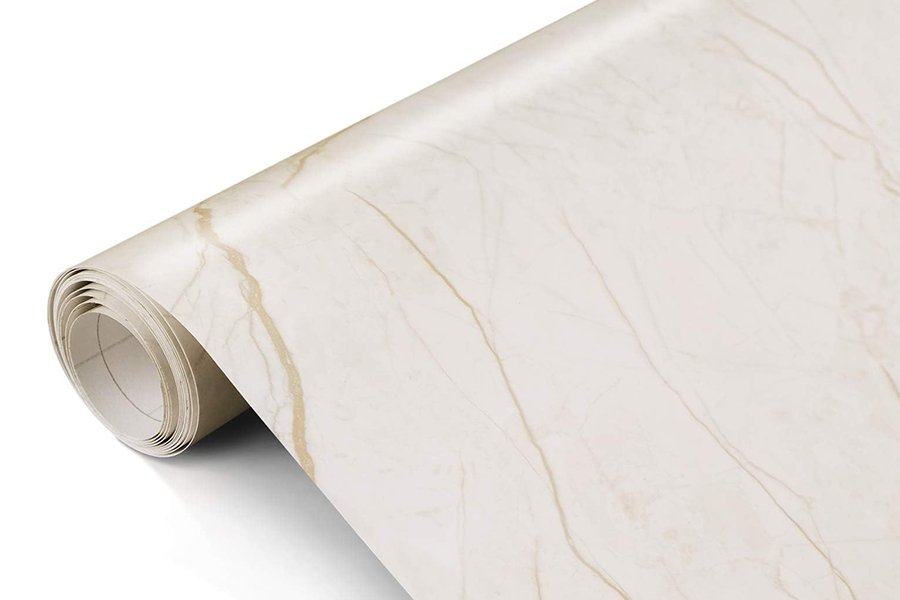
This is the most widely used form. Gravure printing — using engraved cylinders to transfer ink in precisely controlled dot patterns — is the dominant print process for PE decorative film in high-volume production. It delivers exceptional colour fidelity, fine pattern resolution, and consistent repeat accuracy across rolls of hundreds or thousands of linear meters. Printed PE decorative films are used extensively in furniture edge banding, cabinet door overlays, decorative packaging, and consumer product wrapping where a wood grain, marble, textile, or geometric pattern finish is required at low material cost. Flexographic printing is also used for simpler patterns at medium production volumes, offering faster changeover and lower tooling cost than gravure.
Embossed PE Decorative Film
Embossing adds a three-dimensional surface texture to the film by passing it through heated embossing rollers that imprint a relief pattern into the softened polyethylene surface. When combined with printed decoration, embossed PE film creates highly convincing tactile and visual simulations of natural materials — wood grain films with embossed pore texture, leather-look films with pebbled surfaces, and stone-effect films with irregular surface relief are all produced by this method. The depth and fidelity of the embossed texture depend on roller engraving quality, film thickness, temperature control during embossing, and the specific grade of PE resin used. LLDPE and metallocene PE grades generally produce sharper emboss definition than standard LDPE due to their more uniform molecular weight distribution.
Metallized PE Decorative Film
A thin aluminium layer — typically 20 to 40 nanometres thick — is vacuum-deposited onto the PE film surface to create a metallic reflective finish. Metallized PE decorative film is used in premium packaging, gift wrap, cosmetic product overwrap, and display applications where a high-gloss silver or gold visual effect is required at lower cost than aluminium foil laminate. The metallic layer can be printed over with transparent inks to produce coloured metallic finishes — gold, bronze, holographic, and rainbow effects are all achievable through this combination process.
Holographic PE Decorative Film
Holographic decoration is applied by embossing a diffractive grating pattern into a metallized PE film surface. The grating diffracts light into its spectral components, producing the shifting rainbow visual effect associated with holographic materials. Holographic PE decorative film is used in anti-counterfeiting labels, premium packaging, stationery, and decorative applications where visual impact and brand security are both priorities. The holographic pattern can be customized to incorporate brand logos, geometric motifs, or text elements that are visible only when the film is viewed at specific angles.
Key Technical Specifications to Evaluate
Specifying PE decorative film requires matching a set of technical parameters to the demands of the end application. The following table summarizes the most critical specifications and their practical significance:
| Specification | Typical Range | Why It Matters |
| Film Thickness | 20 – 200 microns | Determines mechanical protection level, conformability, and lamination suitability |
| Tensile Strength (MD/TD) | 10 – 35 MPa | Affects tear resistance and film integrity during application and use |
| Elongation at Break | 200 – 600% | Higher elongation enables wrapping of curved and profiled surfaces |
| Surface Energy (after treatment) | 38 – 44 dynes/cm | Must be sufficient for reliable ink adhesion and lamination bonding |
| Gloss Level | 5 – 90 GU (60° geometry) | Determines the visual finish from matte to high gloss on the decorated surface |
| UV Resistance | Standard or UV-stabilized grades | UV-stabilized grades required for outdoor or high-light-exposure applications |
| Operating Temperature Range | -20°C to +60°C (standard PE) | Standard PE softens above 60°C; specify crosslinked or blended grades for higher temperatures |
| Adhesive Type (if self-adhesive) | Acrylic, rubber-based, hotmelt | Adhesive chemistry determines bond strength, removability, and temperature resistance |
Major Application Areas and Industry-Specific Requirements
PE decorative film serves a broad range of industries, each with distinct performance requirements that influence specification decisions significantly. A film that performs perfectly in furniture lamination may be entirely unsuitable for food packaging or outdoor signage without modification.
Furniture and Interior Panel Decoration
In furniture manufacturing, PE decorative film is laminated onto MDF, particleboard, plywood, and solid wood substrates to create cost-effective simulations of wood grain, stone, fabric, and abstract patterns. Films used in this context must exhibit high bond strength to the substrate adhesive system (typically EVA or PUR hotmelt), resistance to household chemicals including cleaning agents and dilute acids, and sufficient surface hardness to resist scratching from everyday use. Thickness in this application typically runs from 80 to 150 microns, with embossed texture being the norm for wood and stone simulations. The film's dimensional stability under temperature cycling is critical — a film that contracts or expands significantly with temperature changes will cause visible bubbling or edge lifting on panel surfaces over time.
Packaging and Consumer Product Wrapping
Decorative PE film for packaging applications prioritizes print quality, heat-sealing performance, and machinability on high-speed packaging equipment. Films in this category are typically thinner — 25 to 60 microns — and must run reliably through form-fill-seal machines, flow wrappers, and overwrap equipment at line speeds of 100 to 400 packages per minute without jamming, stretching, or tearing. Coefficient of friction (COF) values must be controlled within tight tolerances to ensure consistent film tension and registration accuracy on printing and converting equipment. Food-contact applications require PE resin grades that comply with applicable food safety regulations such as EU 10/2011 or FDA 21 CFR, with documented evidence that all additives and colorants used in the film construction are approved for the intended contact category.
Construction and Architectural Surface Films
Decorative PE films used in construction applications — wall cladding, ceiling panels, window profiles, and door skins — face more demanding environmental exposure than interior furniture films. UV stability is the primary concern: without adequate UV stabilization, polyethylene film will yellow, become brittle, and lose adhesion within 12 to 24 months of exposure to sunlight. UV-stabilized grades incorporating HALS (hindered amine light stabilizers) and UV absorbers can extend outdoor service life to 5 years or more, depending on the intensity of UV exposure at the installation location. Scratch resistance and chemical resistance to cleaning products used in commercial and institutional building maintenance are also critical performance criteria in this segment.
Surface Treatment and Print Compatibility Considerations
The fundamental challenge in decorating polyethylene film is its naturally low surface energy — untreated PE has a surface energy of approximately 31 dynes/cm, well below the 38 dynes/cm minimum required for reliable ink adhesion. Without surface treatment, inks bead up and fail to wet the surface uniformly, producing patchy color, poor dot gain control, and ink that rubs off readily after printing.
Corona discharge treatment is the standard solution: the film passes between a high-voltage electrode and a grounded roller, generating a plasma discharge that oxidizes the film surface and introduces polar functional groups — hydroxyl, carbonyl, and carboxyl groups — that dramatically increase surface energy to 40 to 44 dynes/cm. This treatment is typically applied either in-line during film extrusion or immediately before the printing operation. Because corona treatment effectiveness decreases over time as treated surfaces revert toward lower energy states — a process called ageing — treated film should ideally be printed within days of treatment and stored in cool, dry conditions to slow the reversion rate.
Primer coatings offer an alternative or complementary approach to corona treatment, applying a thin layer of chemically compatible primer that acts as a bonding bridge between the PE substrate and the ink system. Primers are particularly valuable when printing with water-based inks, which present greater wetting challenges on PE than solvent-based or UV-curable ink systems.
Environmental and Regulatory Considerations
The environmental profile of PE decorative film is an increasingly important factor in supplier selection and product specification, particularly in markets where extended producer responsibility (EPR) regulations, plastic packaging levies, or voluntary sustainability commitments influence procurement decisions.
- Recyclability: Monomaterial PE films — where the entire construction, including adhesive and ink layers, is compatible with the PE recycling stream — are increasingly preferred over multi-material laminates that contaminate recycling processes. Some manufacturers now offer PE decorative films specifically designed for mechanical recyclability, with water-washable adhesives and compliant ink systems.
- Recycled content: Post-consumer recycled (PCR) and post-industrial recycled (PIR) PE resin can be incorporated into decorative film formulations at levels of 20 to 50% without significant compromise to print quality or mechanical performance in many applications. Buyers should request documentation of recycled content percentages and chain-of-custody certification from suppliers.
- Restricted substance compliance: Decorative films must comply with applicable restricted substance lists for their end-use market. In Europe, this includes REACH regulation compliance and the restriction of substances of very high concern (SVHCs). In the US, California Proposition 65 compliance is relevant for consumer product applications.
- Bio-based PE options: Bio-based polyethylene, produced from sugarcane-derived ethanol rather than fossil feedstocks, is chemically identical to conventional PE and offers a reduced carbon footprint. It is available in decorative film grades from several major resin producers and carries USDA BioPreferred or equivalent certification in applicable markets.
Selecting the right PE decorative film requires balancing visual performance, mechanical durability, surface treatment compatibility, application-specific regulatory compliance, and an increasingly important set of sustainability criteria. Suppliers who can provide complete technical data sheets, application test results on relevant substrates, and documented compliance certifications across all applicable regulatory frameworks are the most reliable partners for both initial specification and long-term supply consistency.